Artist biography
Oleg Tselkov
1934–2021 · Moscow — Paris
Painter and major figure of Soviet unofficial art
Biography
Life and work
Oleg Tselkov was born on 15 July 1934 in Moscow, USSR, and died on 11 July 2021 in Paris.
From 1949 to 1953 he studied at the Moscow Central Art School. He then spent a year at the Belarusian Theatre and Art Institute in Minsk, from which he was expelled for ‘formalism’ in 1954, and another year at the Repin Academy of Arts in Leningrad, where he was expelled in 1955. That year he entered the stage-design department of the Leningrad State Institute of Theatre, Music and Cinema, studying with the celebrated director and artist Nikolai Akimov. He graduated in 1958 with a diploma as a stage designer-technologist.
Tselkov’s first apartment exhibition took place in Moscow in 1956 and was organised by the artist Vladimir Slepyan in his flat on Trubnaya Street. In 1957 Tselkov took part in the Third Exhibition of Works by Young Artists of Moscow and the Moscow Region, where his work was sharply criticised in the press but noticed and highly praised by the Chilean poet Pablo Neruda. Tselkov returned to Moscow in 1961. Writers, poets and artists including Louis Aragon, Anna Akhmatova, Joseph Brodsky, Renato Guttuso and David Siqueiros visited him in Tushino. Georgy Costakis, the renowned collector of the Russian avant-garde, was among the first to acquire his paintings.
Under pressure from the authorities, Tselkov left the USSR in 1977. He lived in Paris and later bought a farm in Champagne, about 300 kilometres from the capital, where he established his studio. From 1977 to 1988 he taught at the École nationale supérieure des beaux-arts in Paris. He did not accept French citizenship and remained stateless for almost four decades; in June 2015 he became a citizen of the Russian Federation.
A few weeks before his death, the artist lost his sight, a devastating blow for him. He died at Saint-Antoine Hospital in Paris on 11 July 2021, four days before his eighty-seventh birthday. He was buried in Champagne, in the cemetery near the commune of On-le-Val, where his country home stood.
Artistic practice
A singular pictorial language
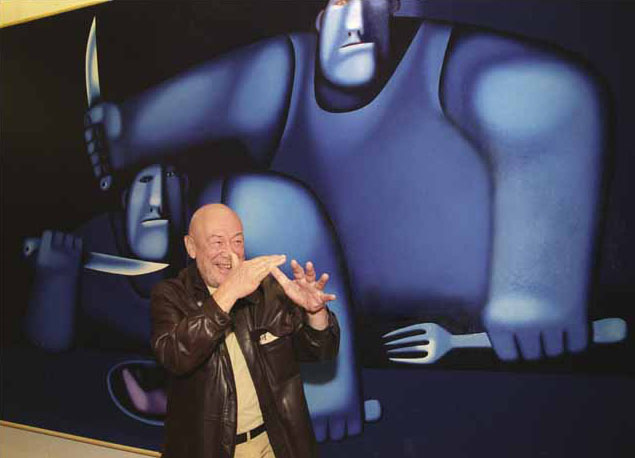
Oleg Tselkov was one of the leaders of Soviet nonconformism. From 1960, beginning with the painting Portrait, he developed a single central subject: deformed human faces and figures resembling sinister masks or humanoid mutants. This impersonal ‘mask-face’, which the artist himself called a ‘mug’ or ‘snout’, remained at the centre of his art for decades. He said that he encountered the image by chance and that the discovery profoundly shocked him. His portraits became a distinctive response to the formal innovations of the Severe Style.
“Even in the earliest works, Tselkov was feeling his way towards a language that was laconic, expressive, impenetrable and shimmering with the mystery concealed behind the mask’s half-smile or grimace. It is hardly surprising that this ability to speak directly to future generations, as well as to ancestors hidden in storerooms, had a shocking effect on his contemporaries.”— Zhanna Vasilyeva, ‘The Artist Who Tore the Mask from Humanity: Oleg Tselkov’s Exhibition The Alien’
His paintings are distinguished by their serial quality, monumental scale and intense aniline colours. To achieve chromatic depth, Tselkov used a multilayered technique, applying numerous layers of paint and translucent glazes. From the early 1970s he drew on Rembrandt’s method of building colour through successive layers. By the 1980s his fully individual visual language had taken shape. Dark grounds and deep violet tones characterised a number of works from that decade; vivid pinks combined with green, violet, blue and orange appeared frequently in the late 1990s. In the early 2000s his palette became lighter and paler, with blue, pink and yellow predominating. His work was influenced by modern primitivists and the late Malevich.
Tselkov did not belong to any of the artistic groups formed in the 1960s. In his view, dissidents who tried to prove something to the authorities placed themselves on the same level as power; he did not consider himself part of that ‘game’. Alongside painting, he created bronze and ceramic sculpture and worked in etching.
Selected works
Works
Further images, provenance documentation and condition reports are available on request.
Works by Oleg Tselkov will be added to the gallery selection shortly.
Enquire about the artistExplore the programme